Why Qantas Gave Up 162 Seats On Its Airbus A350-1000ULR To Charge 20% More To London
Qantas's decision to strip 162 seats from a standard Airbus A350-1000 configuration to enable its Sydney-London Project Sunrise service represents one of the most aggressive payload-range tradeoffs in modern commercial aviation, and it offers a clear window into the economics that govern ultra-long-haul flying. The A350-1000ULR variant, entering service in October 2027, carries 238 passengers versus the 350-400 a standard three-class configuration would hold, with 41% of that reduced capacity dedicated to premium cabins. The math is unforgiving: every kilogram devoted to the 5,283-gallon rear center fuel tank, structural reinforcement, and enhanced landing gear is a kilogram that cannot go toward passengers, bags, or cargo within the aircraft's maximum takeoff weight. Qantas is betting that a smaller number of high-yield passengers willing to pay a 20% premium over one-stop competitors like Emirates, Singapore Airlines, and Qatar Airways will generate more revenue per flight than a fuller aircraft flying a less differentiated route.
For working pilots, particularly those flying ultra-long-haul international routes or eyeing careers at carriers pursuing similar missions, this program is a case study in how far airframe manufacturers can stretch existing platforms without new type certification. The ULR variant is externally identical to the standard A350-1000 — same fuselage length, same wingspan, same Trent XWB-97 engines — yet gains roughly 700-1,000 nautical miles of range through internal structural changes, a taller wingtip for drag reduction, and a fundamentally redesigned galley cooling system built to sustain catering integrity across flights approaching 22 hours. That last detail matters operationally: crew rest, catering logistics, and cooling system reliability on a 20-hour-plus sector introduce fatigue and systems-management considerations that don't exist on a standard 14-16 hour A350 mission. Pilots flying these routes will be operating at the outer edge of human duty-time regulation and aircraft endurance simultaneously, and the certification campaign now underway — focused specifically on fuel system and galley cooling performance — reflects how much of this program's risk sits outside the flight deck in the passenger cabin and fuel architecture.
The broader significance for the industry lies in what this configuration reveals about ultra-long-haul economics more generally. Qantas's Project Sunrise has been discussed for nearly a decade as the "last frontier" of nonstop connectivity, but this seat count confirms that true 10,000nm nonstop flying is not currently viable at mainline density. The 41% premium cabin ratio — far exceeding Cathay Pacific's 14% or Singapore Airlines' 26% on comparably sized A350-1000s — signals that carriers attempting genuine ultra-long-haul routes must essentially convert the aircraft into a boutique product rather than a mass-market one. This has direct implications for network planners and corporate travel departments: nonstop capacity on these routes will be scarce and expensive by design, not by market accident, and airlines will need sustained premium demand to justify dedicating widebody hulls to routes carrying barely 60% of a standard aircraft's typical payload.
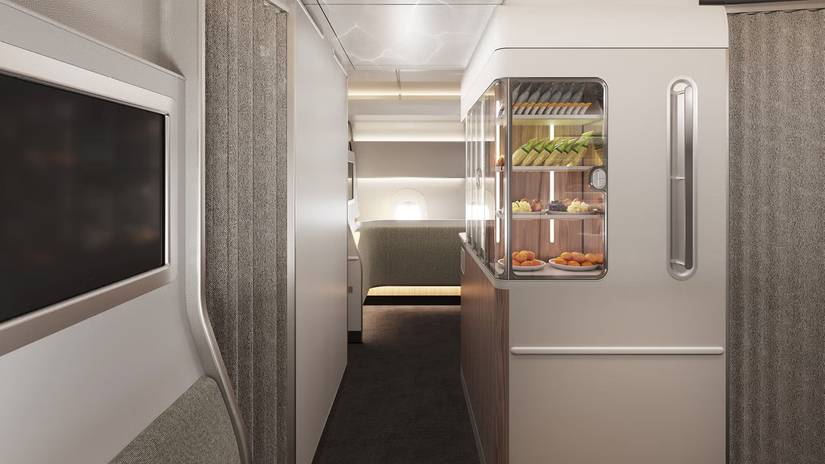
Finally, the Wellbeing Zone and its focus on inflight physical health signals an emerging design trend that extends beyond Qantas. As airlines push aircraft toward the absolute limits of range, passenger fatigue and wellbeing are becoming certification-adjacent design priorities rather than marketing afterthoughts, and Airbus's willingness to co-develop lighter galley cooling architecture specifically to preserve cabin space for non-revenue wellness areas suggests manufacturers are treating human factors as a genuine constraint in ultra-long-haul airframe design. Business aviation operators flying long transoceanic legs in large-cabin jets have grappled with similar crew and passenger fatigue tradeoffs for years; Qantas's program essentially imports that thinking into scheduled commercial service at a scale the industry hasn't previously attempted, and its commercial success or failure will likely shape whether other carriers pursue similar ultra-long-haul, low-density strategies on their own next-generation widebodies.





 Read original article