After 60 Years: Why The US Air Force Is Finally Ready To Retire The T-38 Talon
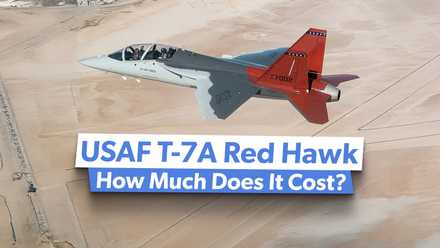
The United States Air Force has formally authorized full-rate production of the Boeing T-7A Red Hawk advanced jet trainer in May 2026, marking the beginning of the end for the Northrop T-38 Talon after more than 60 years of continuous service. The T-38, which entered operational service in 1961, has trained an estimated 75,000 USAF pilots and over 50,000 international partner pilots across its service life — a testament to the airframe's foundational role in shaping the global fighter pilot pipeline. The program milestone arrives after years of developmental delays on the T-7A, caused primarily by deficiencies in the emergency escape system and flight control software. Brigadier General Matthew Leard, Director of Plans, Programs, Requirements, and International Affairs at Air Education and Training Command, characterized the replacement as a top priority, citing the need to align student training environments with the cockpit realities of 5th- and 6th-generation platforms now entering and advancing through the force.
The core operational problem driving the transition is a widening training gap created by the T-38's analog architecture. Pilots graduating from the Talon arrive at F-22 or F-35 fleet replacement squadrons lacking familiarity with large-area displays, sensor fusion workflows, hands-on throttle-and-stick inputs, and data-link management — all of which are native to 5th-generation cockpit design. This forces a significant portion of early fleet training hours to be devoted to basic cockpit familiarization rather than combat tactics and mission systems employment. The T-7A directly addresses this by mirroring the display geometry and HOTAS architecture of the F-35 and F-22, allowing student pilots to develop sensor fusion and systems management instincts from the first syllabus event. The aircraft can internally simulate radar returns, targeting pod feeds, and adversary threat environments on its cockpit displays without external pods, compressing what previously required expensive and logistically complex hardware into a software-driven training environment.
Maintainability represents an equally significant operational advantage for training commands managing throughput against aging fleet serviceability. The T-38 fleet's age has degraded both aircraft readiness and parts availability, slowing pilot production at a time when USAF requires accelerated output. The T-7A's General Electric F404 engine — derived from the same powerplant family used in the Saab Gripen — is designed to be replaced in approximately 90 minutes using basic tools, while ejection seats can reportedly be exchanged in 15 minutes. These metrics represent a structural reduction in ground time and maintenance labor that will directly increase sortie generation rates at undergraduate pilot training bases. The aircraft's open software architecture additionally allows avionics and simulation capabilities to be upgraded incrementally, avoiding the obsolescence cycles that made sustaining and modernizing the T-38 economically prohibitive.
Perhaps the most consequential feature for the future training enterprise is the T-7A's live virtual constructive integration capability, which allows an airborne student pilot to interact in real time with virtual aircraft and threat environments generated by ground-based simulators. This creates complex, multi-ship combat scenarios — contested airspace management, coordinated sensor employment, threat reaction under cognitive load — that were structurally impossible to replicate in the T-38's analog environment. A planned software integration layer will further connect airborne students with ground-based simulator operators, enabling instructor pilots to inject dynamic scenario changes and observe student decision-making across the full kill chain. The enhanced rear cockpit, designed with elevated sightlines described as "stadium seating," also gives instructor pilots substantially improved visibility of student instrument scans and control inputs across all flight regimes, addressing a longstanding instructional limitation of the tandem T-38 configuration.
The T-38 transition reflects a broader pattern visible across military and commercial aviation training: the analog-to-digital cockpit gap has become a systemic workforce development problem, not merely a platform-specific one. As glass-cockpit, fly-by-wire, and sensor-fused aircraft now constitute the overwhelming majority of new deliveries across commercial air transport, business aviation, and tactical military aviation, training pipelines built around older analog platforms create measurable deficiencies in crew resource management, systems monitoring discipline, and data integration skills. The T-7A's open architecture and virtual constructive integration model represent an early institutional acknowledgment that future training value will increasingly be generated through software and simulation fidelity rather than raw aircraft performance. For the broader aviation industry, the Red Hawk program signals that the next generation of professional aviators — whether destined for fighter cockpits, commercial flight decks, or business jet operations — will be expected to arrive with digital systems fluency that legacy training aircraft simply cannot provide.








 Read original article