How The 585,000-Pound C-17 Globemaster Lands On Some Of The World's Shortest Runways
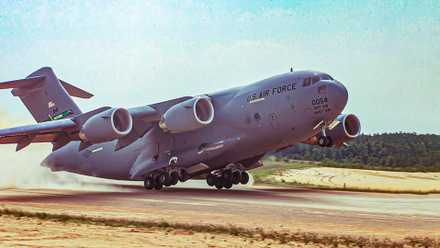
The Boeing C-17 Globemaster III's ability to land a 585,000-pound aircraft on runways as short as 3,500 feet and 90 feet wide represents one of the more consequential aerodynamic engineering achievements in modern military transport, and its underlying technology offers useful context for pilots who operate at the margins of performance envelopes. The externally blown flap (EBF) system, which routes engine exhaust from the four Pratt & Whitney F117-PW-100 turbofans directly over titanium double-slotted flaps, effectively doubles the wing's lift coefficient compared to a conventional jet transport at the same speed. That allows the C-17 to fly a stabilized approach at roughly 115 knots rather than the 140-plus knots a comparably sized airlifter would require, a 25-knot margin that is the difference between an aircraft tied to paved commercial infrastructure and one capable of delivering an M1 Abrams tank to an unimproved forward strip. For pilots accustomed to thinking about approach speed purely as a function of stall margin and flap schedule, the C-17 is a reminder that propulsive lift, not just wing geometry, can be engineered into the equation.
The lineage of this technology matters to anyone interested in how today's aircraft performance capabilities trace back decades of incremental research. The EBF concept originated in NASA Langley studies in the 1950s, was proven on the McDonnell Douglas YC-15 STOL demonstrator in the 1970s under the Air Force's Advanced Medium STOL Transport program, and was subsequently scaled up nearly threefold when McDonnell Douglas won the Cargo-Experimental competition that produced the C-17. That scaling effort required four NASA research centers to rebuild the aerodynamic database essentially from scratch, since simply enlarging a proven low-speed lift system does not guarantee it behaves the same way at triple the weight and thrust. This kind of multi-decade, multi-institution development pipeline is increasingly rare in an era of compressed procurement timelines, and it stands as a case study in why STOL and propulsive-lift technologies, despite their clear operational payoff, have not been widely adopted outside dedicated tactical airlift platforms.
For working pilots, particularly those in military airlift, humanitarian relief, or austere-strip charter operations, the C-17's EBF system is directly relevant to understanding energy management on approach. Engine exhaust interacting with flap surfaces changes the relationship between throttle position, flap deflection, and lift generation in ways that differ fundamentally from a conventional swept-wing jet relying solely on slats and Fowler flaps. Because thrust itself contributes meaningfully to lift, power reductions on approach have a more pronounced effect on the aircraft's ability to stay airborne at low speed, which changes go-around dynamics, stall margins, and the tolerance for late configuration changes. Crews transitioning into or training on the C-17, or evaluating similar propulsive-lift concepts on other platforms, need a mental model that accounts for thrust-dependent lift rather than treating engine output and aerodynamic lift as separate systems.
More broadly, the C-17 underscores a persistent gap in Western strategic airlift: no aircraft built since has replicated its combination of heavy-lift capacity and true austere-field performance, a capability set that remains militarily significant as contingency operations increasingly demand delivery into unimproved or damaged airfields rather than established air bases. Civil and business aviation have generally moved in the opposite direction, favoring runway-independent turboprops and light jets for short-field work rather than large-scale propulsive-lift systems, largely because the complexity, maintenance burden, and titanium hardware required for EBF are difficult to justify outside a dedicated military airlift mission. Even so, the C-17 program illustrates how sustained, well-funded aerodynamic research can produce performance capabilities that remain unmatched decades later, a point worth remembering as newer commercial and business aircraft programs face pressure to deliver STOL-like performance with far smaller R&D budgets and much shorter development timelines.










 Read original article