Why The F-35B Is The Only Stealth Fighter That Can Land On A Finnish Highway
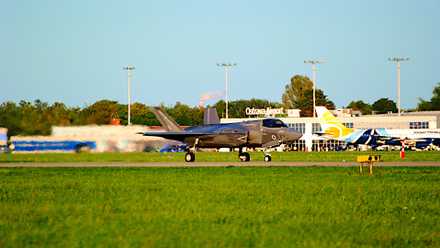
The F-35B's demonstrated highway operations near Tervo, Finland, in June 2026 represent a meaningful data point in how NATO is rethinking fighter basing in an era of persistent long-range strike threats. The exercise, conducted under the umbrella of Ramstein Flag 2026, saw US Marine Corps F-35Bs from VMFA-224 operate off a closed section of Highway 5 roughly 200 miles from the Russian border, alongside Spanish F-18s and Polish F-16s, with fuel and munitions support from a Marine Wing Support Squadron FARP team. What distinguishes this event from prior Finnish highway exercises—including Norway's Baana 23 and the USAF's 2024 F-35A deployment—is the aircraft type involved. The F-35B's shaft-driven LiftFan and vectoring rear nozzle allow it to decelerate, hover, and set down vertically, meaning it can use a road segment far shorter, narrower, and more irregular than anything a conventional F-35A or F-35C could accept. That distinction is not cosmetic; it changes the calculus of where a fifth-generation stealth asset can realistically be based, serviced, and relaunched in a contested theater.
For working pilots and operators, particularly those flying military, government, or dual-use platforms, the exercise underscores a broader shift in how airpower planners think about runway independence and basing survivability. Fixed air bases—Rovaniemi, Rissala, Tampere Pirkkala in Finland's case—are known quantities to any adversary's targeting cycle. A temporary road strip that can be activated and struck down within hours introduces genuine ambiguity into an adversary's planning, and it forces reconsideration of what "resilient basing" even means. Civil and business aviation professionals who operate into austere, unimproved, or non-standard strips will recognize the underlying logic: short-field performance, reduced infrastructure dependency, and rapid turnaround capability are operational multipliers regardless of airframe category. The FARP concept demonstrated at Tervo, refueling and rearming a combat aircraft on a public road within an exercise timeline of days, also has downstream relevance for contingency planning in any operation where prepared infrastructure may be denied, degraded, or simply unavailable, a scenario increasingly discussed in business aviation risk planning near contested regions.
The technical backstory reinforces why this capability nearly didn't exist. The shaft-driven lift fan was one of the most contentious design elements of the Joint Strike Fighter program, with early 2000s Pentagon reviews seriously questioning whether the STOVL variant's weight, complexity, and thermal management challenges justified its continuation. That the F-35B ultimately delivered roughly 40,000 lbf of combined vertical thrust, enough to hover and set down a 32,000-pound empty-weight fighter with no forward roll, validates a design bet that could easily have been cancelled. For program watchers and military aviation professionals, the Tervo exercise is a reminder that variant-specific engineering decisions made two decades ago continue to shape operational flexibility today, and that STOVL capability, once dismissed by some as a niche requirement primarily for expeditionary Marine Corps and Royal Navy carrier operations, is now being repurposed as a core NATO deterrence tool along the Russian frontier.
More broadly, this fits into a widening trend across NATO air forces toward distributed operations, dispersed basing, and reduced reliance on centralized, easily targeted infrastructure, a concept the US Air Force calls Agile Combat Employment and allied air forces are adopting under various names. Ramstein Flag 2026's scale, 18 nations across more than 15 locations from northern Norway to southern Spain, signals that this is not an isolated experiment but a deliberate, alliance-wide posture shift. For commercial, business, and general aviation operators, the exercise is a useful reminder that military demand for short-field, minimal-infrastructure performance is accelerating investment in technologies, from vertical lift to advanced STOL, that historically migrate into civil derivatives over time. It also signals that airspace users operating near Nordic and Baltic exercise areas should expect continued growth in NOTAM activity, temporary flight restrictions, and road-based military operations as NATO expands this basing concept to additional locations and aircraft types in the coming exercise cycles.







 Read original article