The Navy Jet That The US Air Force Was Forced To Fly & Eventually Loved
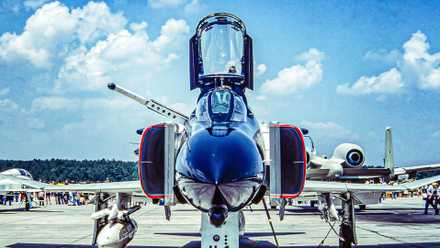
The McDonnell Douglas F-4 Phantom II stands as one of the most consequential procurement decisions in American military aviation history, a Navy-born fleet defense interceptor that became the backbone of US Air Force tactical aviation for more than three decades. Originally designed to protect carrier battle groups from Soviet bombers, the Phantom entered Air Force service not through organic institutional desire but through the direct intervention of Defense Secretary Robert McNamara, who forced a common platform agreement in the early 1960s to reduce duplication and control defense spending. Initially designated the F-110 Spectre before the standardized F-4 designation was applied, the aircraft the Air Force resisted became the platform it would ultimately rely upon across virtually every tactical mission set — air superiority, close air support, deep strike, and electronic warfare suppression.
What made the F-4 so operationally durable was an engineering philosophy that prioritized raw capability over refinement. Powered by two General Electric J79 afterburning turbojets producing over 17,000 pounds of thrust each, the Phantom could climb vertically at more than 40,000 feet per minute and exceed Mach 2 in intercept configuration — performance figures that many of its nominal successors, including the F-16 and F/A-18, never matched in top speed. Its nine hardpoints accommodated up to 18,650 pounds of mixed ordnance, a payload capacity that exceeded the jets that replaced it in both the Air Force and Navy inventories. This combination meant a single F-4 sortie could deliver bombs on a defended target, prosecute a radar-guided missile engagement, and egress at speeds that denied enemy fighters a sustained pursuit — effectively collapsing three single-role aircraft into one airframe.
The Vietnam War forced American tacticians to confront the F-4's genuine aerodynamic limitations against lighter, more agile Soviet-built MiG-17s and MiG-21s in close turning engagements, but those same combat lessons accelerated doctrinal evolution rather than producing an indictment of the platform. USAF crews refined energy-management tactics, leveraging the Phantom's superior thrust and speed to dictate engagement geometry through boom-and-zoom approaches rather than sustaining horizontal turning fights. Out of Vietnam also emerged the Wild Weasel concept — dedicated suppression of enemy air defenses — a mission for which the F-4G variant proved so capable that it remained the primary SEAD asset through the 1991 Gulf War, nearly two decades after fourth-generation fighters had entered service. The aircraft's adaptability across successive generations of avionics and weapons integration, achieved by gutting obsolete electronics and installing updated systems without fundamental airframe changes, allowed operators to defer replacement far longer than conventional acquisition timelines would have suggested.
The Phantom's legacy carries direct relevance for today's aviation operators and defense planners because it established the template for what a true multirole platform must deliver: payload fraction, kinematic performance, systems-upgrade potential, and operational commonality across service branches. That template directly influenced the requirements driving the F-15E Strike Eagle, the F/A-18E/F Super Hornet, and ultimately the tri-service F-35 Lightning II program — which, like the F-4 before it, faced significant inter-service resistance before becoming a common platform under budget pressure. Greece, Turkey, and Iran continue to operate upgraded F-4 variants in active service as of the mid-2020s, a testament to the airframe's structural and aerodynamic longevity. For professional aviators and operators evaluating fleet decisions today, the F-4's history illustrates that institutional resistance to common platforms is often overcome by fiscal reality, and that over-engineered, highly adaptable airframes frequently outlast their planned replacements by a generation or more.








 Read original article