Dassault Flies Its Biggest, Fastest Falcon
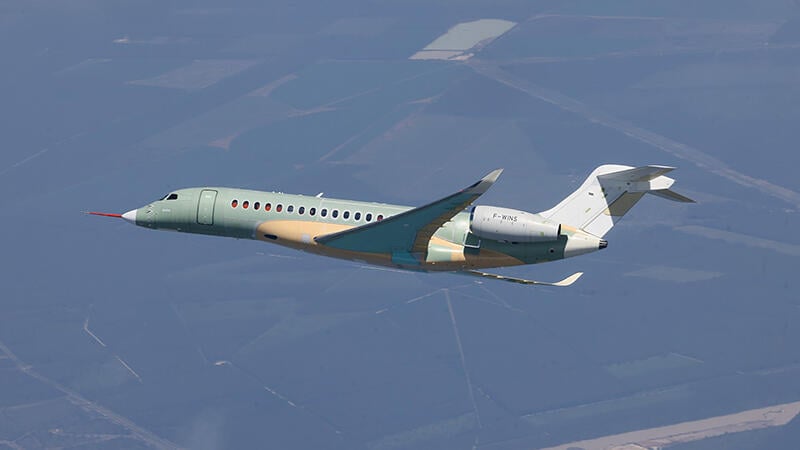
Dassault Aviation completed the first flight of the Falcon 10X on June 19, 2026, marking a significant milestone for the French airframe manufacturer as it enters flight test with its largest and most capable business jet to date. The aircraft lifted off from Bordeaux-Mérignac Airport in southwestern France and conducted a 2-hour, 30-minute inaugural sortie, reaching 45,000 feet and Mach 0.82 before returning to the field. Powered by Rolls-Royce Pearl 10X turbofans, the 10X represents Dassault's direct answer to the ultra-long-range widebody segment dominated by Gulfstream and Bombardier, and its successful first flight initiates what will be an extended certification campaign before entry into service.
The Falcon 10X has been positioned since its 2021 announcement as the widest-cabin business jet in its class, with a cross-section that Dassault has described as more closely resembling a narrow-body airliner than a traditional business jet. The aircraft is designed for transcontinental and transoceanic operations with a published range target in the vicinity of 7,500 nautical miles, enabling nonstop city pairs such as New York to Dubai or Los Angeles to Sydney that remain beyond the reach of most competing platforms. The Pearl 10X engine, a variant of Rolls-Royce's Pearl family developed specifically for this application, provides the thrust and fuel efficiency required to achieve those range figures while meeting increasingly stringent environmental standards. For operators and flight departments currently flying Falcon 7X or 8X fleets, the 10X represents a significant step up in both payload-range capability and cabin volume.
For professional pilots and corporate flight departments evaluating ultra-long-range platforms, the 10X's entry into flight test carries direct operational significance. Certification programs of this scope typically span two to three years across multiple test aircraft, meaning entry into service is likely to fall in the 2028–2029 timeframe. Pilots already qualified on the Falcon FMS architecture and avionics philosophy will find the 10X's flight deck evolutionary rather than revolutionary, as Dassault has historically maintained strong commonality across its Falcon family in systems logic and cockpit design. That commonality reduces type-transition training burden and is a consideration fleet operators weigh heavily when standardizing on a single airframe manufacturer.
The first flight comes at a moment when the ultra-long-range business jet market is experiencing significant competitive pressure and sustained demand from high-net-worth individuals, fractional operators, and government VIP transport programs. Gulfstream's G700 has been in service since 2022 and the G800 entered certification in the same period, while Bombardier's Global 7500 remains the range benchmark in the segment. Dassault's ability to bring the 10X to market with a differentiated cabin width proposition will determine how effectively it competes for orders in a segment where buyers are increasingly sophisticated about trading off range, speed, cabin environment, and operating cost. The Pearl 10X powerplant also positions the aircraft favorably with respect to sustainable aviation fuel compatibility, a growing consideration among corporate operators facing ESG reporting obligations and regulatory pressure on business aviation emissions. The successful first flight removes development risk and signals to the order book that the program is progressing on trajectory.








 Read original article