15-Hour Nonstop Flights: Explore Virgin Australia's 10 Longest Routes In 2026 [Map]
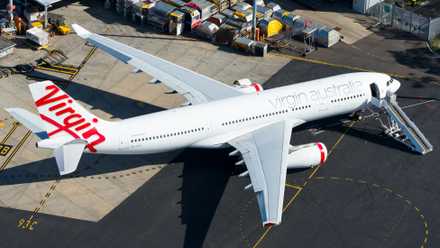
Virgin Australia's 2026 long-haul network presents one of the more structurally unusual arrangements in contemporary commercial aviation: its longest routes — four daily or near-daily services connecting Sydney, Melbourne, Brisbane, and Perth to Doha Hamad International Airport — are operated entirely by Qatar Airways crews and Boeing 777-300ER aircraft under a wet-lease agreement, marketed under Virgin Australia flight numbers. The Sydney–Doha sector, at 14 hours and 50 minutes, is the network's longest pairing, followed closely by Brisbane–Doha at 14 hours 40 minutes. Perth–Doha and Brisbane–Doha services were temporarily suspended during the 2026 Iran Crisis, with both routes scheduled to resume in December. The Qatar Airways investment of 25% in Virgin Australia created the commercial framework for this arrangement, and industry analysts have noted that the wet-lease structure effectively allows Qatar Airways to extend its Australian reach beyond the 28 round-trip weekly cap that Australian bilateral agreements impose on foreign carriers — a regulatory workaround that has drawn scrutiny but remains operationally active.
For professional pilots, the wet-lease model is operationally significant because it draws a sharp distinction between the marketing carrier and the operating carrier, with all regulatory responsibility, crew certification, and airworthiness compliance sitting with Qatar Airways rather than Virgin Australia. Pilots operating these services hold Qatar Airways employment credentials, follow QR standard operating procedures, and operate under QCAA and GCAA regulatory oversight — not CASA. This means that from an operational standpoint, a Virgin Australia flight number on these routes is essentially a Qatar Airways long-haul operation in full, and dispatch, fuel planning, and OCC communication structures reflect that reality. Corporate flight departments considering codeshare positioning or interline agreements with Virgin Australia on these sectors should understand that the operating carrier's policies — including irregular operations handling and crew rest requirements — will govern the experience.
Virgin Australia's own-metal international operation is exclusively narrowbody, with Boeing 737 MAX 8s and legacy 737-800s covering routes to Bali's Ngurah Rai International Airport from Sydney, Canberra, Gold Coast, Brisbane, and Melbourne, with sector times ranging from 6 hours 25 minutes to 6 hours 45 minutes. These represent meaningful range performance for the MAX 8 platform, operating near the upper boundary of typical narrowbody international deployments in terms of duration. The Gold Coast–Bali sector at up to twice daily and the Sydney–Bali daily rotation demonstrate that Virgin Australia is leveraging MAX 8 economics to capture high-demand leisure routes that historically required widebody lift. The Canberra–Bali thrice-weekly service is notable for originating from a smaller capital city airport, underlining the airline's strategy of feeding leisure demand from secondary markets without requiring hubbing through Sydney or Melbourne.
The network's sole domestic long-haul operation — a weekly Brisbane–Karratha service at 6 hours 10 minutes — exists entirely to serve Western Australia's resource extraction sector, connecting the east coast to the Pilbara mining region. This type of FIFO (fly-in, fly-out) contract flying is a structural feature of Australian commercial aviation largely invisible to international observers but economically material for regional operators and charter providers across the continent. Virgin Australia's participation in this market via scheduled service on the 737-800 reflects both the scale of mining industry travel demand and the airline's interest in capturing institutional corporate travel contracts beyond the leisure and business travel segments. The absence of a widebody order from Virgin Australia — despite CEO-level commentary about future fleet ambitions — means the airline will continue to depend on the Qatar Airways wet-lease arrangement for any long-haul growth in the near term, a structural dependency that limits Virgin Australia's operational autonomy even as its network footprint expands.





 Read original article