The Airlines With The World's Most Spacious Economy Seats In 2026
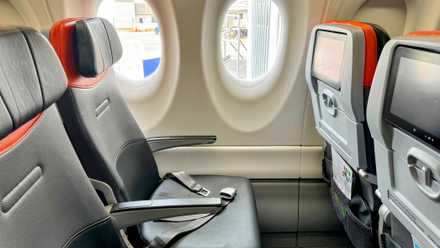
Gulf carriers and select global airlines continue to set the benchmark for economy class seating dimensions in 2026, with Qatar Airways, Emirates, and Singapore Airlines leading a field that prioritizes measurable legroom and seat width over soft product amenities. Using aeroLOPA database figures as a consistent reference, Qatar Airways offers a standard 31-inch pitch and 18-inch width across most of its fleet, with Boeing 777 variants configured at a slightly tighter 17.3-inch width but expanded 32-inch pitch, and certain 787-8 subfleets delivering 34-inch pitch as an outlier at the more generous end. Emirates standardizes at 32 inches of pitch across its remarkably simplified three-aircraft-type fleet, with width variations of 17.3 inches on the 777, 17.9 on the A380, and a full 18 inches on the newer A350-900. Singapore Airlines matches the 32-inch standard on the bulk of its widebody fleet and delivers 18.5-inch width on its A380s, though its 787-10 and 737 MAX 8 subfleets fall slightly short of those figures due to the constraints of those aircraft cabins. JetBlue rounds out the ranking as a notable narrowbody outlier, achieving 32 or more inches of pitch alongside 18-inch width on aircraft types that competitors typically configure more densely.
For airline pilots who regularly deadhead on other carriers, these distinctions carry immediate practical value. Crew rest quality on repositioning flights is directly tied to seat geometry, and a 34-inch pitch on a Qatar 787-8 versus a 28-inch seat on a densely configured narrowbody represents a materially different recovery environment over a six-to-ten-hour flight. Pilots traveling internationally for type rating training, simulator recurrency, or fleet transitions — common occurrences for crews at major network carriers and for contract pilots serving Part 135 operators — frequently have limited control over which airline or aircraft type they deadhead on. Understanding which subfleets within a given carrier offer more generous dimensions helps inform any scheduling flexibility they may negotiate. Emirates' fleet simplicity is particularly notable in this regard: with only three aircraft types all standardized at 32-inch pitch, crew deadheading on Emirates faces far less configuration uncertainty than on a carrier with highly variable subfleet configurations.
For corporate flight department managers, chief pilots, and Part 91K fractional operators, this data holds relevance when advising passengers or executives who mix private and commercial travel. Business aviation clients accustomed to flatbed seating frequently face the commercial cabin when budget constraints, aircraft availability, or regulatory positioning requirements dictate commercial routing. The growing gap between the most spacious economy products — which now approach some early-generation premium economy dimensions from a pitch standpoint — and the most compressed economy configurations underscores why carriers like Singapore Airlines and Emirates have built strong corporate travel relationships. Their economy products function as a credible fallback option in a way that a 28-to-29-inch seat on a dense narrowbody does not.
The broader industry context reflected in this ranking is the continued consolidation of product differentiation strategy around measurable hardware rather than soft product alone. Emirates' disclosure that it is investing billions in cabin retrofits across its existing fleet amid Boeing 777X delivery delays illustrates how seriously legacy widebody operators are treating the long-term competitive risk of falling behind on seat specifications. The inclusion of JetBlue in a list otherwise dominated by long-haul full-service international carriers signals that the low-cost carrier segment — at least in the U.S. — has found market traction in treating economy seat space as a differentiated product rather than a cost to be minimized. This trend has broader implications for the regional and domestic markets in which many U.S.-based Part 135 operators compete for the same travelers, reinforcing why the value proposition of private aviation continues to center on cabin geometry, scheduling flexibility, and the elimination of the densification pressures that govern commercial airline seat planning.






 Read original article