WestJet's Massive Expansion: 13 New International Routes Launching This Year [Map]
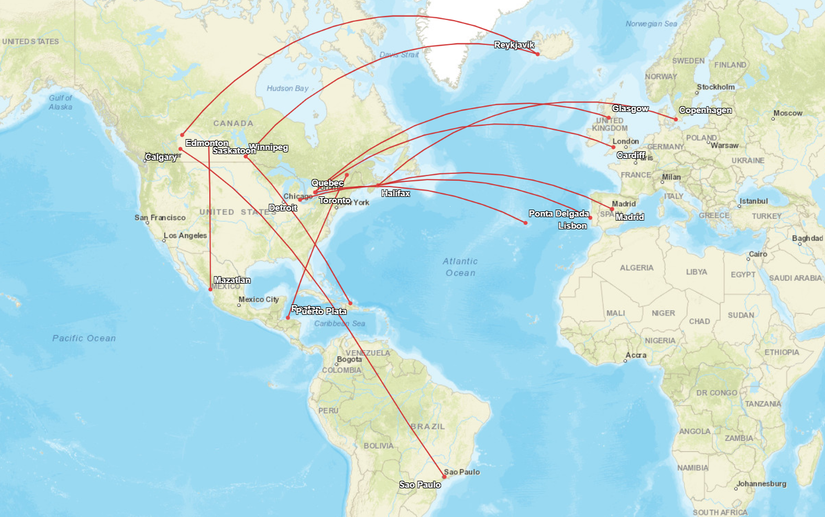
WestJet's 2026 international expansion represents one of the Canadian carrier's most geographically ambitious network buildouts in recent years, with Cirium scheduling data confirming 13 new international routes launching from May onward. The growth is notably distributed across the country rather than concentrated at a single hub, with Halifax, Toronto, Calgary, Winnipeg, Edmonton, Québec City, and Saskatoon all receiving new international service. Halifax leads the expansion with four new routes — seasonal transatlantic service to Copenhagen, Lisbon, and Madrid on the Boeing 737 MAX 8, plus a seasonal domestic-international hybrid to Detroit on standard 737s. Toronto contributes three additional European corridors: Ponta Delgada in the Azores (commenced June 12), Cardiff, and Glasgow, all operated seasonally with 737 MAX 8 configurations carrying 12 premium and 162 economy seats. Calgary adds a long-haul Boeing 787-9 Dreamliner route to São Paulo, while smaller markets including Winnipeg, Edmonton, Québec City, and Saskatoon pick up leisure and VFR-oriented routes to Iceland, the Dominican Republic, Honduras, and Mexico.
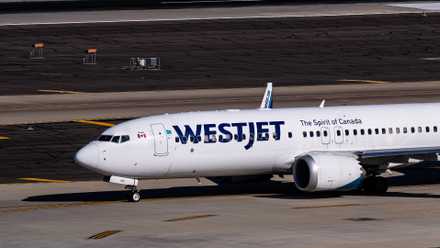
For professional pilots and aviation operators, the most technically significant element of this expansion is WestJet's continued aggressive deployment of the 737 MAX 8 on transatlantic routes. The Halifax-to-Europe corridors and the Toronto-Azores routing (4,524 km / 2,443 nautical miles) demand rigorous ETOPS planning, and operators tracking fleet capability benchmarks will note that WestJet's transatlantic MAX operations extend well beyond the aircraft's initial operational intent in North American markets. The 12-seat premium cabin configuration on the European routes reflects a deliberate product decision to compete for connecting business traffic rather than operating purely as a leisure carrier on thin margins. Flight crews and dispatchers operating or monitoring these corridors should anticipate North Atlantic Track System integration, extended fuel planning, and the regulatory complexity inherent in single-aisle widened-body-equivalent ETOPS operations.
The Calgary–São Paulo route on the 787-9 merits separate attention, particularly because its seasonal window has already been compressed from a five-month November-to-April schedule down to a tighter December-to-February window. That contraction, reported by Pax News prior to publication, suggests demand modeling or slot/partnership constraints that did not support the originally planned scope. For charter and Part 135 operators eyeing transatlantic and transequatorial long-haul markets, this kind of mid-planning-cycle schedule revision is a useful reminder of the commercial fragility of newly certified long-haul seasonal routes, even when operated by a major carrier with established widebody infrastructure. Calgary to São Paulo is a market thin enough that even WestJet, with 787 lift, couldn't sustain five months of service in the inaugural year.
At a broader strategic level, WestJet's expansion illustrates a structural shift playing out across North American network carriers: the deliberate push to originate international traffic from secondary hubs rather than funneling everything through a single gateway. Halifax's transatlantic growth, Winnipeg's dual-destination international schedule, and Saskatoon picking up a Mexican sun route all reflect the post-pandemic recognition that regional airports can sustain international demand when correctly priced and marketed — particularly in leisure and visiting-friends-and-relatives segments. For business aviation operators and FBOs positioned at airports like YHZ, YWG, and YEG, increased international commercial service at those fields tends to drive complementary growth in general aviation traffic, customs infrastructure investment, and international FBO activity. Airlines building out secondary hub international networks have historically preceded GA operators expanding their own cross-border footprints at those same airports, a trend worth monitoring as WestJet's 2026 routes mature through their first full seasonal cycle.









 Read original article