Gulfstream opens dedicated customer support office in Singapore | Corporate Jet Investor | CJI news
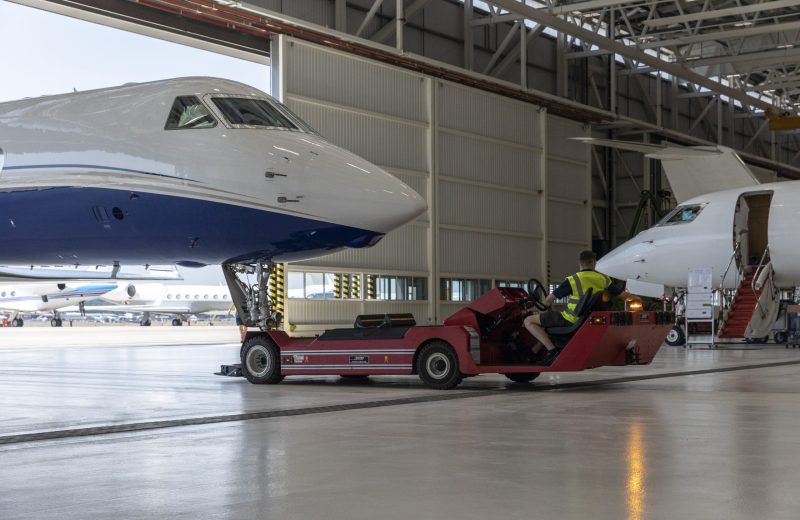
Gulfstream Aerospace has formalized its Asia-Pacific service infrastructure with the establishment of a dedicated customer support office in Singapore, co-located at Jet Aviation's facility at Changi Airport. The eight-person team covers technical management, materials, quality assurance, field service, and regional sales — a staffing profile that signals intent to handle complex, in-region support needs rather than routing operators back to Savannah or other Western service hubs. The office builds on an already substantial regional presence that includes nine field service representatives, three FAST airborne support teams deployable across Asia-Pacific, and a 5,000-square-foot distribution center that carries more than $70 million in spare parts inventory and fulfills over 70% of parts orders originating from the region.
The choice of Singapore is operationally deliberate. Changi Airport functions as one of the premier MRO and business aviation hubs in the world, with favorable customs infrastructure for aircraft parts, a well-developed regulatory environment under CAAS, and geographic positioning that puts it within practical ferry range of major demand centers across Southeast Asia, Northeast Asia, and Australasia. Jet Aviation Singapore's status as one of only six Gulfstream factory-authorized service centers globally further concentrates resources at a single high-capability node, reducing the logistical complexity operators face when scheduling heavy maintenance or AOG support in-region.
For corporate and business aviation operators flying Gulfstream products — particularly G650ERs, G700s, and G800s on the ultra-long-range Pacific routes that Singapore frequently anchors — the practical implication is faster access to technical decision-makers and parts without the time-zone friction of coordinating with North American support desks. AOG events in Asia have historically been costly precisely because of parts lead times and the limited authority of in-region representatives to approve technical dispositions. A locally empowered team with materials and quality personnel on-site directly compresses that response chain.
The move reflects a broader strategic calculus across OEMs and MRO providers as business jet fleet density in Asia continues to grow, driven by high-net-worth wealth concentration in Greater China, Southeast Asia, and the Indian subcontinent. Bombardier has similarly expanded its Singapore footprint, and Dassault maintains regional technical coverage through authorized partners. For Gulfstream specifically, with more than 3,500 aircraft in global service, the concentration of support infrastructure in Singapore represents an acknowledgment that post-sale service quality is increasingly a competitive differentiator in fleet acquisition decisions, particularly for operators evaluating long-term ownership costs on aircraft in the $75–$80 million new-purchase range. The Singapore office positions Gulfstream to defend and grow market share in a region where competitor OEMs are making equivalent bets on proximity-based support as a retention tool.