How Many Miles Per Gallon Does An F-16 Fighting Falcon Get?
The F-16 Fighting Falcon's fuel consumption figures underscore a foundational principle that governs all turbine-powered aviation: jet engines are profoundly inefficient at low speeds and high power settings, and the metrics used to evaluate that inefficiency matter enormously. The F-16 achieves approximately 0.7 miles per gallon in a clean cruise configuration at 30,000 feet subsonic, but that number collapses to less than 0.01 MPG under full afterburner — a condition that sees the single Pratt & Whitney F100 turbofan consuming roughly three gallons per second, or approximately 60,000 pounds of fuel per hour. Cruising efficiently, the fighter burns around 3,000 pounds per hour. The article correctly identifies why miles per gallon is an inadequate metric for aviation: aircraft operate in a three-dimensional fluid environment where fuel volume fluctuates meaningfully with temperature while mass remains constant. Pounds per hour — the standard used across military, commercial, and business aviation — eliminates that variability and provides a stable basis for flight planning regardless of ambient conditions or fuel temperature.
The fuel-to-airframe weight relationship described in the article is directly relevant to any pilot managing performance calculations at heavy weights. The F-16's 19,000-pound airframe accepting an additional 7,000 pounds of fuel produces a meaningful degradation in thrust-to-weight ratio on departure, improving progressively as fuel burns off. This dynamic appears in every turbine aircraft: business jets and airliners alike exhibit their worst climb performance and highest fuel flows early in flight, with efficiency improving as gross weight decreases. The article's observation that low-altitude flight cuts fuel efficiency roughly in half — because denser air forces the engine to work harder — mirrors what every turbine pilot observes when comparing fuel flows at cruise altitude versus those recorded during climb through lower, denser air. The underlying aerodynamics are identical whether the platform is a Viper or a Gulfstream.
From an operational cost and fleet management perspective, the comparison between the F-16, F-22, and F-35 carries implications that extend well beyond military procurement. The F-16's per-hour operating cost advantage over the F-35 — which the article notes delivers only limited additional combat capability while costing exponentially more to procure and operate — mirrors tensions that commercial and business aviation operators face when evaluating newer-generation aircraft with advanced avionics and reduced direct operating costs against legacy platforms that are fully depreciated and well understood. The F-35's readiness challenges referenced in the article echo a recurring theme in aviation: technologically sophisticated platforms frequently underperform their theoretical operating cost projections due to maintenance complexity, parts availability, and specialized support requirements.
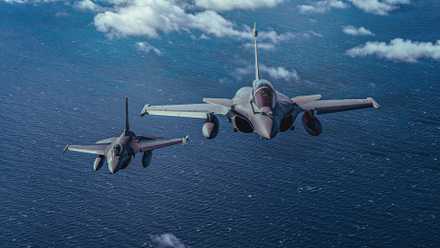
The Dassault Rafale's superior cruise efficiency relative to the F-16, despite its twin-engine configuration, illustrates how advances in aerodynamic design can overcome the inherent fuel consumption penalty of additional powerplants. The Rafale's delta-canard configuration generates low induced drag in level cruise, allowing it to achieve better specific range than the single-engine Viper. This principle is well understood in civil aviation: the Boeing 787's composite airframe and advanced high-bypass turbofans allow it to operate more efficiently than older twin-aisle designs despite broadly similar mission profiles. Aerodynamic refinement and propulsion efficiency gains compound, and the generational gap between the F-16's 1970s design lineage and the Rafale's 1990s origins represents roughly the same technological distance as that between a first-generation business jet and a modern large-cabin aircraft. The article's broader point — that the F-16 endures not because it is the most capable or efficient platform available, but because its acquisition and operating economics remain compelling — is a logic that operators across all segments of aviation will immediately recognize.






 Read original article