Northern Jet adds two Bombardier Challenger 604s to fleet | Corporate Jet Investor | CJI news
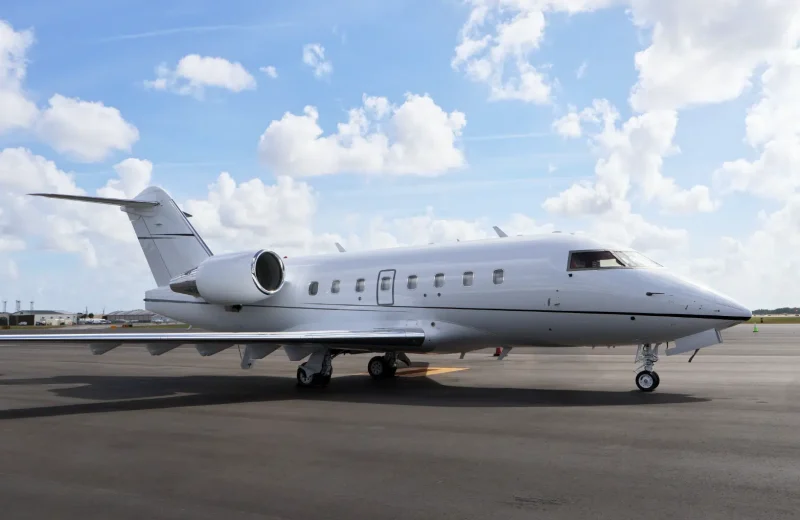
Northern Jet, the Orlando-based operator, has expanded its heavy jet inventory with the addition of two Bombardier Challenger 604 aircraft, both configured to accommodate between 9 and 12 passengers and equipped with Starlink high-speed satellite Wi-Fi. The additions follow closely on Northern Jet's announcement earlier in the same month of a 2026 Bombardier Challenger 650, signaling an accelerated push into the heavy jet segment by an operator whose historical positioning has leaned toward mid-size and super-midsize categories. CEO Chris Bull framed the acquisitions explicitly around client demand for longer-range, higher-capacity options, citing flexible access to heavy jets as a growth driver across the company's service programs.
The Challenger 604 is a well-established platform in the heavy jet market, certified under Part 25 and powered by General Electric CF34-3B engines producing approximately 8,729 pounds of thrust each. It carries a published range of roughly 4,077 nautical miles with typical loads, making it capable of transcontinental and select transatlantic routing without intermediate fuel stops under favorable conditions. For flight crews, the aircraft is operated under Part 135 certificate authority in charter configurations and demands type ratings with specific recurrent training requirements, typically fulfilled through CAE or FlightSafety International simulator programs. The 604's avionics suite, while not glass-forward by modern standards, is operationally mature and well understood by the heavy jet pilot community, which reduces transition friction when operators integrate used examples into managed fleets.
From an operational standpoint, the dual acquisition strategy — pairing legacy 604s with a new Challenger 650 — reflects a deliberate tiering approach increasingly common among mid-market operators seeking to serve a wider revenue band without committing entirely to new-production aircraft costs. The 650 delivers improved range, updated avionics, and enhanced cabin amenities, while the 604s offer cost-effective heavy-category capacity that keeps charter pricing competitive on domestic and shorter international segments. This tiering also allows Northern Jet to optimize fleet utilization by routing mission profiles to the most economically appropriate airframe, a calculus that directly affects crew scheduling, duty-time management, and positioning costs for certificate holders operating under Part 135.
The Starlink installation on both 604s is notable and increasingly standard as a competitive differentiator in the business aviation market. High-speed, low-latency connectivity has moved from luxury to baseline expectation among corporate clientele, and operators lacking it face direct competitive disadvantage when clients compare options through jet card or charter platforms. For pilots, Starlink integration also opens practical considerations around electronic flight bag synchronization, real-time weather data uplink, and company data link communications during flight, all of which can modestly reduce workload on longer over-water or transcontinental operations where connectivity gaps previously existed on older SATCOM systems.
The broader trend Northern Jet is tracking reflects sustained demand pressure in the heavy jet segment that has persisted since the post-pandemic charter surge normalized at a higher baseline. Operators across Part 135 and fractional structures have been competing aggressively to grow heavy iron availability as corporate travel departments and high-net-worth clients prioritize range and cabin volume over price sensitivity. Northern Jet's simultaneous expansion of jet card memberships, fractional ownership, and aircraft management programs alongside fleet growth indicates a strategy aimed at capturing recurring revenue streams rather than relying solely on ad hoc charter bookings, a model that demands consistent crewing depth, standardized training pipelines, and reliable dispatch reliability — all factors that ultimately define the pilot workforce and scheduling infrastructure the operator must build to sustain this trajectory.