Universal Aviation earns Stage II IS-BAH for ground handling in Madrid | Corporate Jet Investor | CJI news
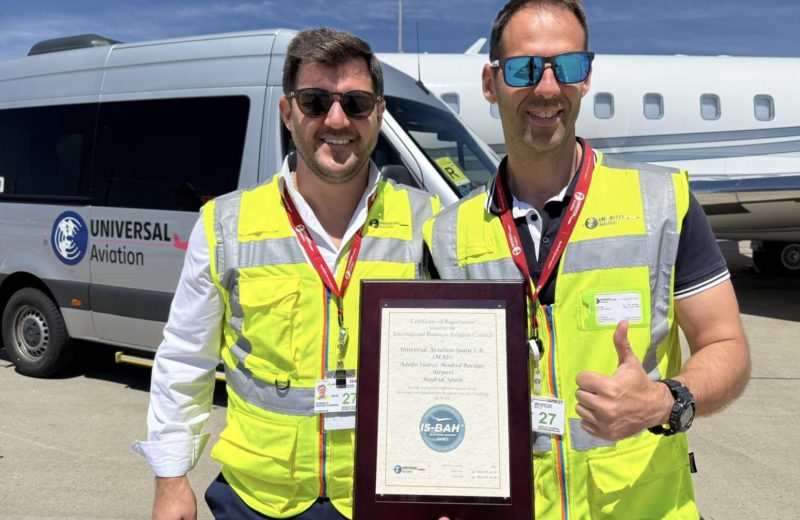
Universal Aviation's ground handling facility at Madrid-Barajas Adolfo Suárez Airport (LEMD) has achieved Stage II accreditation under the International Standard for Business Aircraft Handling (IS-BAH), a globally recognized safety and operational benchmark administered by the National Air Transportation Association (NATA) and the International Business Aviation Council (IBAC). Stage II represents a meaningful progression beyond the baseline Stage I certification, signaling that a handler's safety management system (SMS) has moved past initial documentation and implementation into demonstrable, consistent daily application across all ramp and support operations. For operators selecting ground handling partners in Europe, the distinction between Stage I and Stage II carries practical weight — it reflects not just whether an SMS exists on paper, but whether it is actively governing crew behavior, equipment protocols, and hazard identification in real-time operational conditions.
Madrid-Barajas is one of the busiest business aviation gateways in southern Europe, functioning as both a commercial hub and a key entry point for high-net-worth traffic flowing into the Iberian Peninsula and onward to Mediterranean destinations. The timing of this accreditation is operationally significant: the Mediterranean peak season runs roughly May through September, during which LEMD handles a sharp increase in bizav movements tied to leisure travel, corporate summits, and regional economic activity. For flight departments and charter operators scheduling Madrid missions during this window, a ground handler carrying IS-BAH Stage II status provides a credible assurance that ramp safety margins will be maintained even as aircraft density and operational tempo rise. Universal Aviation's 24-hour service model at LEMD, combined with its proprietary ground support equipment — including towbarless towing, lavatory and water service, and dedicated passenger and crew lounges — positions the operation as a full-service handler capable of supporting demanding schedules without reliance on third-party subcontractors for critical functions.
The upcoming Madrid Grand Prix, scheduled for September 11–13, 2026 at the new MADRING circuit, adds a significant demand spike to an already busy late-season period. Formula 1 events historically generate some of the highest-density bizav traffic of any recurring sporting event, with hundreds of aircraft movements concentrated across a short window at host airports. Barajas experienced comparable pressure during the 2024 Champions League Final and has managed major diplomatic and royal state visits, but an F1 race weekend at a circuit designed specifically for the Madrid market represents a new operational benchmark for the airport and its handlers. Operators planning September missions should anticipate slot congestion, elevated parking demand, and compressed ground time windows — conditions under which a handler's SMS maturity and local authority relationships become directly consequential to mission success.
The IS-BAH accreditation landscape more broadly reflects a sustained industry push to bring structured safety management to the ground handling sector, which historically received less regulatory scrutiny than flight operations despite being the environment where many business aviation incidents and accidents occur. Ramp collisions, FOD events, fuel misfueling incidents, and pushback accidents are statistically significant risk categories at FBO and handling operations worldwide. IBAC's tiered IS-BAH framework — with three progressive stages — gives operators a structured, third-party-verified way to evaluate handler safety culture rather than relying solely on reputation or price. As more corporate flight departments and charter operators adopt formal vendor qualification processes and integrate ground handler SMS status into their own internal safety programs, IS-BAH accreditation is shifting from a differentiator to an expected baseline in many markets. Universal Aviation's continued expansion of IS-BAH-certified locations across its European network reflects a broader competitive dynamic in which safety credentialing is becoming a procurement criterion rather than simply a marketing asset.