8 Aircraft That Have Broken The Sound Barrier
Supersonic flight history encompasses a remarkably small number of civilian and operational military aircraft, and the distinctions between purpose-built supersonic platforms and those that merely touched transonic or supersonic speeds under specific conditions carry direct implications for understanding aircraft performance envelopes. The Douglas DC-8 stands as the lone conventional tube-and-wing airliner to have exceeded Mach 1, doing so deliberately in a controlled dive in August 1961 to reach Mach 1.012 for just 16 seconds. That test, conducted to evaluate a new leading-edge wing design, underscores a principle relevant to any high-performance flight operation: aerodynamic configurations optimized for efficient subsonic cruise can, under the right conditions of altitude, weight, and attitude, momentarily exceed their intended speed regime. The DC-8 subsequently entered normal airline service with Canadian Pacific, its supersonic moment a footnote rather than a design intent.
Among active military supersonic platforms, the Rockwell B-1B Lancer occupies a notable position as the United States' only operational supersonic bomber, with a top speed of Mach 1.25. Its development history illustrates the interplay between evolving threat environments and aircraft design compromise: the original B-1A was intended for Mach 2.0 low-level penetration, but advances in look-down radar technology and Soviet air defense forced a redesign that traded raw speed for reduced radar cross-section. The B-1B is now projected to remain in service into the 2030s, bridging the gap until B-21 Raider numbers grow, even as Russia has responded to strategic bomber attrition losses in Ukraine by restarting low-rate Tu-160 production. These force structure decisions shape airspace and operational considerations in contested environments that military aviators and defense contractors continue to navigate.
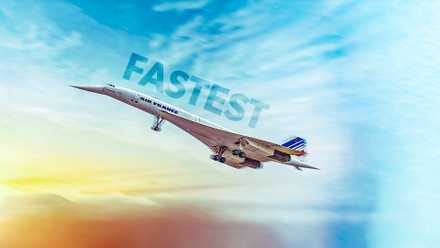
The Concorde's legacy remains central to any discussion of civil supersonic aviation, and the article's framing of it as a political rather than commercial project is analytically significant. The Anglo-French treaty that produced Concorde was never economically self-sustaining — British Airways and Air France received their aircraft essentially as government gifts — yet its indirect consequence was the institutional foundation for Airbus, which reshaped global commercial aviation competition. For operators and professional pilots, Concorde represented a ceiling that has not been approached in over two decades: its Mach 2.04 maximum speed exceeds the projected Mach 1.7 cruise speed of Boom Supersonic's Overture, the most advanced supersonic transport currently in development, which has attracted orders from United Airlines and American Airlines. The article explicitly notes that Overture will not match Concorde's speed, a commercially relevant benchmark for operators evaluating next-generation fleet options.
The broader trend emerging from this survey is that supersonic capability is contracting rather than expanding in both military and civil contexts. The B-21 Raider and China's H-20 represent the next generation of strategic bombers, and both are subsonic, prioritizing stealth over speed in a strategic calculus that mirrors how threat environments have evolved. On the civil side, no business jet has been certificated or designed for supersonic flight, a gap that remains unaddressed despite decades of interest from the business aviation sector. Aerion's AS2 program collapsed in 2021, and while smaller supersonic business jet concepts continue to surface at trade shows, none has advanced to production. For Part 91 and Part 135 operators, the practical ceiling remains the high-subsonic cruise speeds of current ultra-long-range jets, with any genuine supersonic option still years away from service entry and carrying unresolved questions around sonic boom regulation, route limitations over land, and operating economics at scale.







 Read original article