Singapore Airlines Doubles First Class To Auckland With Boeing 777-300ER Swap
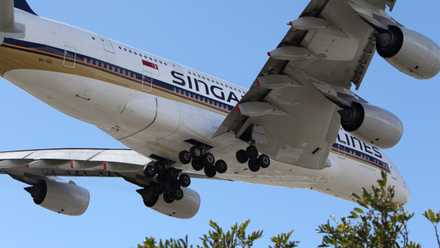
Singapore Airlines is expanding its premium cabin footprint on the Singapore–Auckland corridor by substituting a Boeing 777-300ER for the Airbus A350-900 on its second daily service, flight SQ281, beginning with the northern hemisphere winter season of 2026–27. The swap effectively doubles the airline's first-class availability on the route compared to the same period one year prior, when a single daily 777-300ER service carried the only first-class product on offer before the A380 rotated in for peak January–March travel. The A380 is scheduled to replace one of the two 777-300ER services again in January, restoring the carrier's flagship double-decker and its more contemporary 2017-designed suite to the market. A third daily frequency, operated by the A350-900, will launch from October, bringing Singapore Airlines' peak weekly departures between Singapore Changi and Auckland to 12 — one more than the prior season's maximum.
From an operational standpoint, the aircraft swap carries meaningful implications for crew planning, ground handling, and slot coordination at both ends of the 5,224-mile routing. The 777-300ER and A350-900 differ substantially in seating density and cabin configuration, and the transition affects not only first class but also business class and premium economy capacity, both of which increase under the new arrangement. Economy shrinks by three seats — a negligible reduction that signals the airline's deliberate strategy of skewing yield upward on this pairing. The 777-300ER's first-class suite, configured in a 1-2-1 layout and dating to a 2013 introduction, is older product compared to the A380's iconic suite, and operators and travel managers booking ultra-long-haul premium travel should note that the specific aircraft type will determine the onboard experience until the A380 transition in January.
The Auckland capacity build-up reflects a broader competitive dynamic on the New Zealand–Singapore axis, which is jointly served under a partnership between Singapore Airlines and Air New Zealand. Air New Zealand operates daily Boeing 787-9 services from Auckland to Singapore, and has announced a return of nonstop service from October, adding further frequency to a market that is clearly absorbing renewed post-pandemic demand. The Air New Zealand reactivation of Singapore service — including from Christchurch, where Singapore Airlines already maintains year-round A350-900 operations — signals dual-carrier confidence in sustained premium leisure and corporate travel flows between the two countries. For charter operators and corporate flight departments considering positioning or supplemental lift on transtasman and South Pacific routes, the increase in scheduled premium capacity on this corridor reflects a pattern of airlines aggressively recapturing high-yield travelers who may otherwise turn to private or fractional options.
The broader trend illustrated by Singapore Airlines' Auckland strategy is the deliberate use of aircraft type as a competitive lever on long-haul routes where premium revenue per seat — not load factor — drives profitability. Carriers like Singapore Airlines, Emirates, and Qatar Airways have consistently deployed their widest-body, most premium-configured jets on routes where the business case supports first-class demand, even when the sheer stage length approaches or exceeds ten hours. The SIN–AKL pairing at roughly 8,400 kilometers sits well within practical 777-300ER range and serves a market where premium leisure — particularly around New Zealand's austral summer — justifies the additional fixed costs of operating a heavier, less fuel-efficient frame versus the A350. For professional pilots and aviation operators tracking fleet deployment trends, Singapore Airlines' seasonal rotation strategy — A350 baseline, 777-300ER for premium uplift, A380 for peak — offers a textbook case study in dynamic capacity management on ultra-long routes.





 Read original article