Why Replacing The US Air Force's Dying E-3 Sentry Fleet Has Become Nearly Impossible
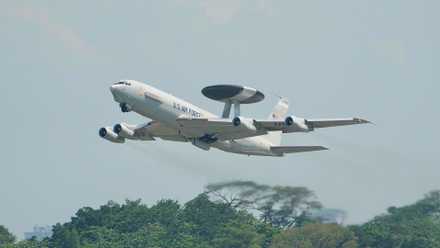
The Boeing E-3 Sentry, the U.S. Air Force's primary airborne warning and control system platform since the late 1970s, has entered what military commanders have openly called hospice care. Of the original fleet of 31 aircraft, only 16 remain operational, and readiness rates across those survivors have deteriorated to the point that sustainment costs now exceed any reasonable cost-benefit threshold. The core structural problem stems from the aircraft's Boeing 707 foundation — an airframe that has not been in production for decades, forcing maintainers to cannibalize boneyard aircraft for parts. More critically, Northrop Grumman, the supplier of the distinctive rotating radar dome, has confirmed that replacing a damaged rotodome is effectively impossible at any price or on any timeline, as the specialized manufacturing equipment and workforce expertise required to produce them were retired years ago. Two major upgrade programs — Block 30/35 (1987–2001) and Block 40/45 (beginning 2003) — extended the aircraft's service life, but also created a complex hybrid of digital and analog systems that has further complicated maintenance and compounded the liability exposure for contractors tasked with structural work on aging dome mounts.
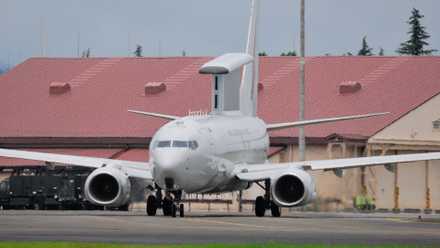
The procurement path forward has become nearly as dysfunctional as the sustainment picture. The Boeing E-7 Wedgetail, long considered the logical successor, saw its per-unit cost escalate to $724 million in 2025 — a 23 percent increase from prior negotiations — prompting the Air Force to attempt cancellation of its own buy. Congress intervened, authorizing continued E-7 funding and blocking further E-3 retirements until a certified replacement is fielded. Simultaneously, the Pentagon explored redirecting procurement funds toward the Northrop Grumman E-2D Advanced Hawkeye, the carrier-based turboprop already proven in U.S. Navy service at approximately $300 million per airframe. Critics of that substitution argue the E-2D represents a meaningful capability regression: the turboprop platform lacks the range, service ceiling, and crew capacity of a jet-powered AWACS, limiting its effectiveness in the contested, high-altitude, long-endurance surveillance missions the E-3 was designed to execute. The result is a program caught between an unaffordable replacement and an inadequate one, with the legacy platform continuing to decay in the interim.
Boeing's broader industrial difficulties have compounded the E-7's problems beyond simple cost growth. The United Kingdom, which contracted for the E-7 expecting an Australian-standard off-the-shelf aircraft, encountered significant delivery delays and was forced to re-certify components that became obsolete while waiting on Boeing. UK Ministry of Defence officials have publicly described Boeing as a "troubled partner" on the program — language that carries significant weight in international defense procurement circles. Australia, the original E-7 developer and operator, confirmed in 2026 that it is already pursuing a replacement under Project AIR7002, with transition beginning as early as 2029. That timeline, representing an extraordinarily short operational tenure for a major defense platform, reflects growing institutional skepticism about the E-7's long-term viability. Meanwhile, NATO as an alliance and individual member nations including France are increasingly turning to the Saab GlobalEye — a modular, wide-body-based system seen as a modern and cost-competitive alternative — while South Korea rejected the E-7 outright in favor of an L3Harris proposal built around Bombardier business jet airframes.
For aviation professionals operating in and around military airspace — including those flying Part 91K or Part 135 charter operations in theater-adjacent regions, or airline crews transiting high-density military exercise corridors — the degradation of the AWACS mission has practical implications. E-3 and similar platforms serve as airborne command-and-control nodes that actively manage complex airspace during exercises, contingency operations, and real-world engagements. Reduced fleet readiness translates directly to reduced coverage, which in turn increases coordination demands on ground-based air traffic control infrastructure and can affect NOTAMs, temporary flight restrictions, and airspace availability in regions where U.S. and allied military operations are concentrated. Business aviation operators flying into European or Pacific theater destinations during NATO exercises have historically dealt with airspace structures that assume robust AWACS coverage; as that coverage thins, those structures may become less predictable.
The E-3's trajectory also illustrates a structural tension increasingly visible across defense and commercial aviation: the compounding cost and irreversibility of operating legacy airframes beyond their intended service lives. Boeing's simultaneous struggles across commercial certification (737 MAX, 777X), military derivatives (KC-46 tanker program), and now the E-7 have drawn sustained scrutiny to whether the company retains the industrial and engineering depth to deliver complex aerospace programs on schedule and on budget. For corporate flight departments and charter operators that rely on Boeing narrowbody and widebody platforms, the institutional health of their primary airframe manufacturer carries direct long-term implications for parts availability, technical support, and certification continuity. The E-3 story, viewed in that broader context, is less about one aging military aircraft and more about the compounding consequences of deferred investment and fractured industrial capacity in a sector where those costs eventually become inescapable.







 Read original article