Boeing’s 30-year march to its next new airplane
Boeing's next clean-sheet commercial aircraft program remains years from launch, but aviation industry analyst Scott Hamilton at Leeham News and Analysis has spent more than three years assembling a detailed picture of what that program—or programs—will look like. The introductory article to LNA's multi-part series establishes the staggering financial and programmatic context: Boeing formally announced the 787 in December 2003, and depending on where one marks the starting line, the company could go 30 years between entirely new aircraft designs. The 787 itself arrived 3.5 years late, accumulated more than $50 billion in cost overruns, deferred production costs, and deferred tooling expenses, and still carries over $14 billion in unrecovered deferred costs. Long-term debt has ballooned from roughly $10 billion in 2018—Boeing's last operationally normal year—to over $54 billion today, with significant repayment obligations approaching. Against that backdrop, certification of the 737-7, 737-10, and 777X remains incomplete, and production rates on both the 737 and 787 lines have yet to recover to pre-MAX-grounding levels.
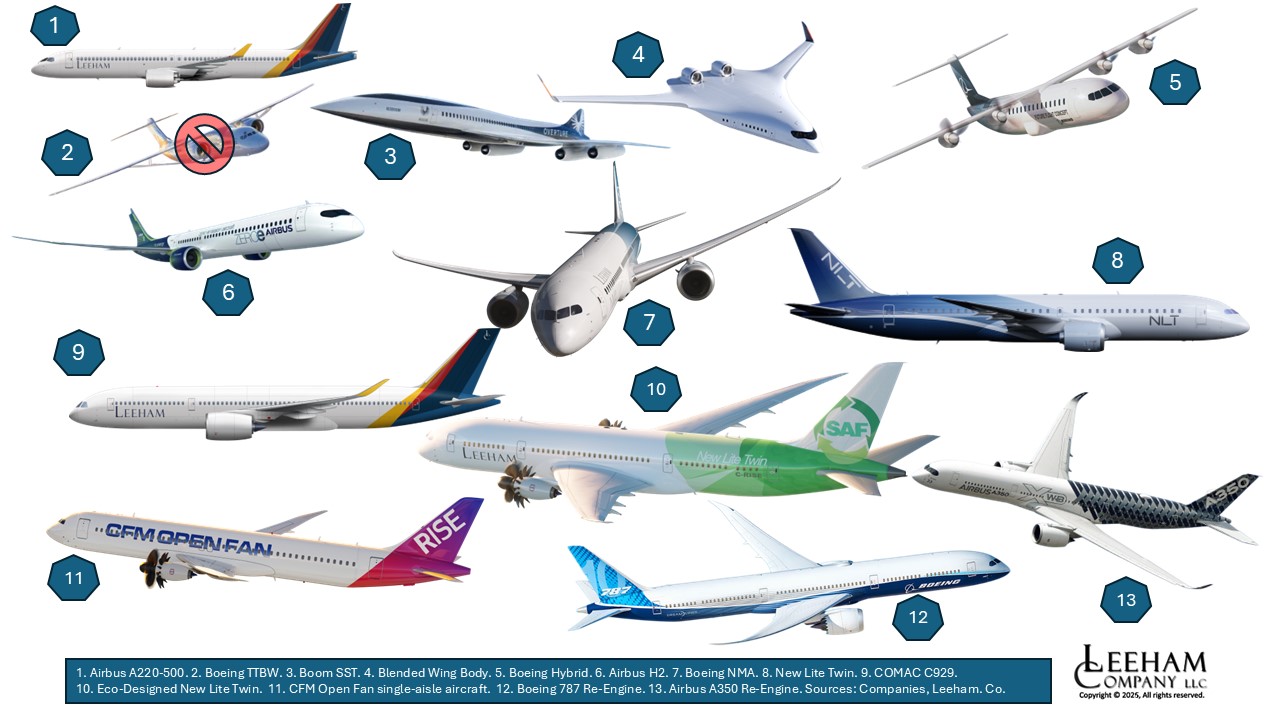
The article traces the internal Boeing debates over what the company's next airplane should be, a dispute that consumed more than a decade of executive bandwidth. The Middle of the Market aircraft concept, championed during CEO Jim McNerney's tenure, pitted widebody advocates like Jim Albaugh and Mike Bair against single-aisle replacement proponents led by Ray Conner. The MOM eventually evolved into the New Midmarket Airplane, a twin-aisle concept sized roughly between the 767-200ER and 767-300ER—a segment long identified as a gap in both Boeing's and Airbus's product lines. Muilenburg's administration advanced the NMA toward board approval, but the March 2019 MAX grounding destroyed the financial and organizational runway needed to launch it. Hamilton notes that NASA wind tunnel work photographed in December 2025 featured a widebody model with large turbofan engines—strongly suggesting NMA geometry—rather than a narrow-body replacement, providing one of several public clues LNA assembled from Boeing CFO Jay Malave and VP of Product Development Brian Yutko's recent public appearances.
For airline operators and fleet planners, the implications are consequential and largely unfavorable in the near term. Boeing's inability to certify its existing derivative programs—the 737-7, 737-10, and 777X—continues to compress fleet planning options for operators who depend on Boeing for single-aisle and large widebody aircraft. Airlines managing aging 757 and 767 fleets, aircraft that the NMA was specifically designed to replace, face an extended period with no purpose-built successor aircraft available. The 757's combination of runway performance, passenger capacity, and transcontinental range has never been replicated in a production airplane, and operators flying thinner transatlantic routes or constrained airports remain in a holding pattern. LNA's indication that Boeing may launch not one but two new programs simultaneously raises questions about whether the company possesses the organizational and financial capacity to execute concurrent clean-sheet development—a challenge that destroyed billions of dollars in value during the 787 program even under far healthier balance sheet conditions.
The broader context for business aviation and Part 91/135 operators is the continued duopoly pressure on the commercial aircraft supply chain that feeds into business jet and turboprop ecosystems. Engine technology, avionics integration, and composite manufacturing advances pioneered in commercial programs routinely migrate into business aviation platforms, and a prolonged Boeing development hiatus affects the pace of those innovations reaching the broader market. Hamilton's caveats—geopolitical disruption, recession risk, the unresolved U.S.-China trade conflict, and supply chain fragility—underscore that even the timelines LNA projects carry significant uncertainty. For pilots and operators making long-horizon fleet decisions today, the clearest near-term signal from this reporting is that Boeing's product pipeline will remain constrained well into the next decade, reinforcing the competitive position of Airbus's A220 and A320-family derivatives in segments where Boeing currently has no certified answer.






 Read original article