UPS Cockpit Audio Reveals Moments Before Fatal Crash After Last-Minute Plane Swap
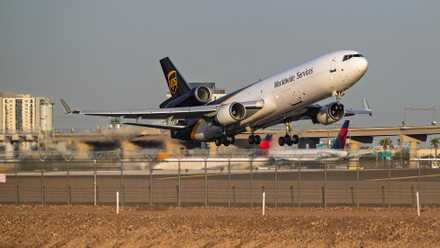
UPS Flight 2976's catastrophic loss in November 2025 has emerged as one of the most consequential cargo aviation accidents in decades, with National Transportation Safety Board investigative hearings in Washington revealing a compounding sequence of maintenance failures, reporting gaps, and last-minute operational decisions that preceded the MD-11 freighter's departure from Louisville Muhammad Ali International Airport. The aircraft, N259UP, was substituted for the originally assigned N260UP after a pre-flight fuel leak rendered that airframe unairworthy, placing the three-pilot crew on a different aircraft with its own distinct maintenance history minutes before a flight to Honolulu. Federal investigators have established that the substitute aircraft's left engine and pylon assembly separated from the wing immediately after rotation, and that post-crash examination of the wreckage revealed fatigue cracking in a critical spherical bearing within the engine mount — a defect that had not been detected during routine maintenance checks. Cockpit voice recorder transcripts described in hearing materials, though not publicly released in full, depict an abrupt cascade of alarms and urgent pilot communications as the crew attempted to recover from an uncontrollable roll, a scenario that unfolded in seconds and offered no viable recovery window.
The last-minute aircraft swap has become a central investigative thread, raising foundational questions about crew familiarity and pre-departure standardization that resonate directly with operational pilots across all certificate types. Under normal circumstances, flight crews — particularly augmented crews on transoceanic cargo operations — arrive with advance knowledge of their specific airframe, maintenance status, and any relevant deferred items. A substitution executed minutes before departure compresses the time available for meaningful review of the replacement aircraft's records, and in this case, the relief officer's walk-around was reportedly casual enough to include jokes with the load supervisor about their coincidental reunion. Investigators have noted that components tied to the failed engine mount had not undergone detailed inspection since 2021, a fact that underscores how a rapid swap can inadvertently transfer a crew from a known-airworthy aircraft to one carrying undetected structural risk. The operational culture surrounding emergency substitutions — and what depth of review is genuinely feasible under time pressure — will likely be a focus of the NTSB's final report.
The broader structural concern dominating the hearing is the documented but systematically underreported history of spherical bearing cracking in the MD-11 engine mounting system. Investigators identified at least ten prior instances of related cracking across the fleet over the preceding fifteen years, yet only a fraction of those findings were formally submitted to the FAA. Boeing had issued guidance recommending replacement of the problematic components but had not mandated corrective action, and federal regulators had not issued an airworthiness directive before the crash. This pattern — where advisory guidance without mandatory enforcement creates a compliance gap across an aging fleet — reflects a known vulnerability in the regulatory framework governing Part 121 maintenance programs, particularly for cargo carriers operating legacy freighter types that generate substantial revenue precisely because acquisition and operating costs are lower than newer platforms. The failure to translate documented field findings into systemic mandatory action represents a regulatory shortcoming that investigators are examining with explicit attention.
The accident has drawn immediate comparisons to the May 1979 loss of American Airlines Flight 191, in which an engine and pylon separated from a DC-10 at Chicago O'Hare during rotation, killing 273 people — the deadliest aviation disaster in U.S. history at the time. The MD-11 is a direct evolutionary descendant of the DC-10, sharing design lineage that includes aspects of the engine mounting architecture, making the structural parallels deeply uncomfortable for safety analysts. Flight 191 triggered sweeping reforms in maintenance practices, pylon inspection requirements, and FAA oversight authority. That a recognizable variant of the same failure mode reappeared more than four decades later on a closely related aircraft type raises serious questions about the durability of those reforms when applied to aging cargo fleets and the effectiveness of inspection intervals calibrated for aircraft in continuous revenue service. UPS has since retired its entire MD-11 fleet, and FedEx resumed operations only after enhanced inspections and revised maintenance procedures received FAA approval, signaling that the regulatory and industry response this time is likely to be substantive — though the NTSB's final probable cause determination, not expected for more than a year, will ultimately define how far-reaching those changes must be.





 Read original article