Pilot Warned Of Fatigue Before Fatal Accident
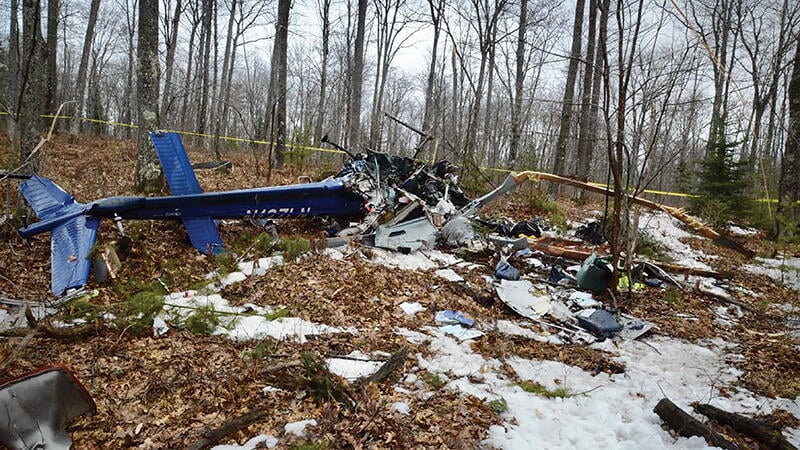
The April 26, 2018, fatal crash of an Air Methods-operated Airbus AS350 B2 near Hazelhurst, Wisconsin, stands as one of the most thoroughly documented cases of pilot incapacitation from fatigue in helicopter emergency medical services (HEMS) aviation. The NTSB determined the probable cause to be the pilot's loss of helicopter control as a result of fatigue during cruise flight at night, after the pilot apparently fell asleep at the controls approximately 96 minutes into a 170-nautical-mile Part 91 repositioning flight from Madison to Woodruff, Wisconsin. Flight recorder imagery captured the precise moment of incapacitation: the pilot's head moved left, the helicopter entered an uncommanded right bank that rolled past 270 degrees, and the aircraft entered a near-vertical dive at 5,000 fpm before impacting a densely wooded area. All three occupants — the pilot and two medical crew members — died on impact from blunt force trauma. The video record also documented multiple preflight warning signs that went unaddressed, including the pilot's own admission — "Good enough to get us home, at least" — when directly asked by a crew member if he was fit to fly.
The contributing fatigue factors in this accident were neither isolated nor subtle, and their stacking effect illustrates precisely the kind of compounding risk that the FAA and ICAO have spent years trying to codify into regulatory frameworks. The pilot had recently returned from a week of family vacation that concluded with a four-hour late-night drive from Milwaukee. On the day of the accident, he woke early to take his children to day care and run errands, with only ambiguous evidence of daytime rest. He then reported for a 12-hour night shift that began at 5:59 p.m. — a schedule that directly conflicts with normal circadian sleep pressure. By the time the crew departed Madison on what was to be the final leg of the shift, they had already accumulated 2.5 hours of mission time and 94 minutes of flight. The crew members in the back verbalized their fatigue openly, one noting she had been awake since 3:30 a.m., and the group discussed company culture around calling out sick, signaling an environment where self-grounding carried a perceived professional cost. This last element — the informal social pressure against removing oneself from duty — is among the most operationally dangerous aspects of any aviation safety culture and directly undermines the written policy Air Methods had in place.
Air Methods' General Operations Manual specified 10 hours of continuous, uninterrupted rest between shifts and placed the compliance burden squarely on pilots through honest self-reporting. The company's SMS contained a preflight risk analysis tool that included human factors considerations, and its internal Safety Connect publication had addressed fatigue risk factors as recently as winter 2017, drawing from FAA Advisory Circular 120-115. Despite this documented awareness, the company had no standalone Fatigue Risk Management System (FRMS) at the time of the accident — a distinction with significant operational consequence. An SMS acknowledges that fatigue exists as a hazard; an FRMS provides systematic, data-driven tools to monitor and mitigate it proactively, including crew scheduling algorithms, biomathematical modeling, and structured mechanisms for reporting fatigue without fear of reprisal. The FAA's AC 117-3, referenced in Air Methods' own publications, classifies fatigue into transient, cumulative, and circadian categories — all three of which were demonstrably present in this crew on the night of the accident. ICAO has further noted that microsleeps, which occur when the brain disengages entirely from environmental input, become increasingly uncontrollable after successive nights of sleep restriction and require at least two full consecutive nights of restorative sleep to reverse.
For working HEMS, Part 135, and corporate flight department operators, this accident is a direct challenge to the structural adequacy of self-reporting as a sole fatigue mitigation strategy. The pilot in this case did not conceal his fatigue — he verbalized it in the cockpit, was observed exhibiting physical signs of drowsiness, and gave a qualified, hedging response when asked point-blank about his fitness. The system failed not because information was withheld, but because no mechanism existed to act on that information before the flight departed. Operators flying night schedules, particularly those with seven-days-on rotations, transient crew positioning, or bases that require crew members to sleep against their circadian rhythm, face structural risk that policy language alone cannot mitigate. The accident reinforces the argument for FRMS implementation across HEMS and Part 135 operators regardless of current regulatory requirements, including anonymous fatigue reporting channels, scheduling models that account for cumulative sleep debt, and crew-level go/no-go authority backed by explicit protection from professional consequences.
The broader aviation industry context surrounding this accident reflects an ongoing tension between operational demand and physiological reality that has produced a consistent pattern of fatigue-related accidents across HEMS, regional airline, and cargo sectors. The FAA's Part 117 rest rules, which took effect in 2014, significantly restructured fatigue management for Part 121 air carrier operations, but HEMS operators under Part 135 remain subject to a less rigorous framework. Industry safety organizations including the Air Medical Operators Association (AMOA) and NTSB have repeatedly identified HEMS fatigue as a systemic concern, and the NTSB has included fatigue risk management improvements on its Most Wanted List of aviation safety improvements for multiple consecutive years. The Spirit 2 accident adds a critical data point to that body of evidence: a fully documented, video-recorded case in which a pilot fell asleep 12 miles from home at the end of a night shift, with crew members aware of the risk and no functional system to stop the flight from departing. The lesson for operators and flight departments is that written fatigue policies are necessary but not sufficient — the culture, scheduling architecture, and reporting environment must together make it safe and easy for a fatigued crew member to say no.







 Read original article