Sky Harbour posts 56% revenue growth in 1Q | Corporate Jet Investor | CJI news
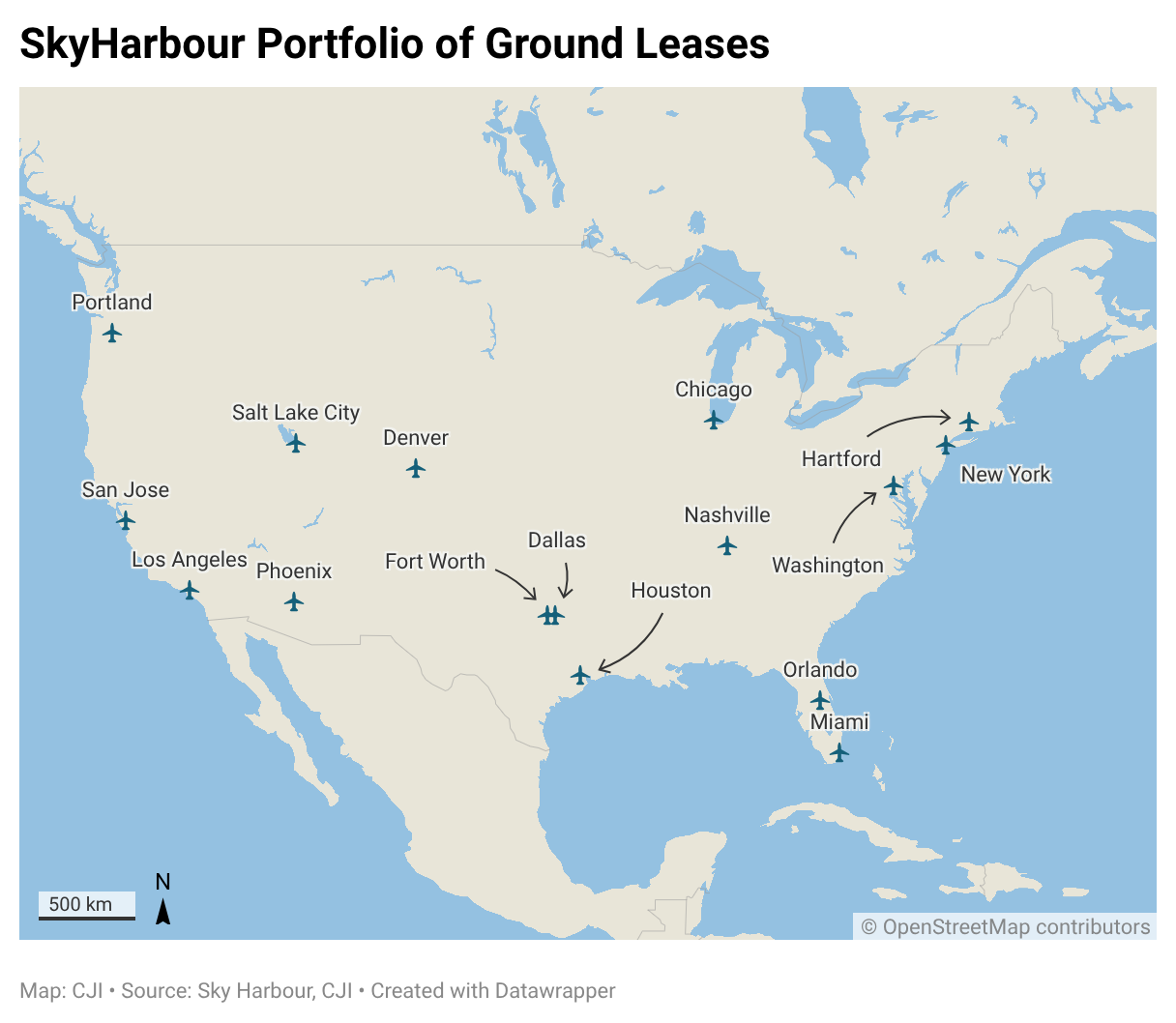
Sky Harbour Group's first-quarter 2026 earnings report confirms what many corporate flight department managers and charter operators have been experiencing directly: premium private aviation hangar space is becoming structurally scarce, and that scarcity is driving aggressive rent escalation across the company's eight-campus U.S. portfolio. The company posted $5.2 million in total quarterly revenue, a 56% year-over-year increase, with operating cash flow nearly tripling to $2.9 million. The most consequential data point for operators is not the revenue headline but the re-lease pricing metric: across approximately 119,000 square feet of hangar space re-leased in the past 12 months, average rent between one lease term and the next increased 23%, and that figure sits on top of contractual annual escalators tied to CPI with a hard floor of 4%. Tenants renewing at stabilized campuses — Sugar Land, Nashville, and Miami Phase 1 are all at or near 100% occupancy — are absorbing compounding cost increases that materially affect the operating budgets of Part 91 flight departments and Part 135 certificate holders alike.
The opening of Miami Opa Locka Phase 2 represents a meaningful operational milestone beyond the financial metrics. Sky Harbour delivered the campus on time and on budget using its proprietary Ascend integrated construction program, which brings architecture, engineering, steel fabrication, and construction management under a single in-house umbrella. The 68% pre-lease rate on opening day at a market with well-documented hangar demand underscores that institutional-grade private aviation infrastructure, when it arrives, is absorbed quickly. CEO Tal Keinan's framing of airport real estate as analogous to Manhattan island is not merely investor rhetoric — the inability to create new airport infrastructure within or adjacent to major metro areas creates a fixed supply constraint that fundamentally differentiates aviation real estate from other commercial property classes. That structural argument is borne out by San Jose's economic occupancy rate of 132%, a figure reflecting the premium tenants pay when options are exhausted.
For operators evaluating long-term hangar arrangements, the Sky Harbour model signals a direction the premium hangar market is moving broadly. The company's observation that residents are actively upgrading from semi-private to fully private hangars at significantly higher rental rates reflects a bifurcation in tenant preference — operators are willing to pay for exclusivity, predictability, and the amenity package that purpose-built campuses provide. The Stewart International expansion, doubling footprint at a Tier 1 New York-area market, suggests the company is deliberately targeting locations where corporate and high-net-worth demand is concentrated and alternatives are limited. Newer campuses at Denver Centennial and Phoenix Deer Valley remain in lease-up at 37% and 71% respectively, which represents near-term availability in those markets but also establishes a pricing baseline that will escalate as occupancy matures.
Sky Harbour's issuance of its first formal financial guidance — projecting an annualized revenue run rate of $42 million to $46 million by year-end 2026 — signals a transition from a development-stage story to an operating business with measurable throughput. With $368 million in available liquidity and only $19 million drawn against a $200 million JPMorgan credit facility, the company retains substantial capital to execute its construction pipeline without near-term financing constraints. The CFO's explicit direction of investor attention toward 2027 and 2028 revenue and EBITDA suggests that the pipeline of projects currently under construction will generate a second material step-up in revenues as they open across the next 18 months. For aviation operators and corporate flight departments negotiating hangar agreements during that window, the implied trajectory is one of continued rent escalation at stabilized sites and rapidly narrowing availability at newly opened campuses — making early commitment to long-term agreements an increasingly defensible financial decision.