Here's How Qantas Plans To Charge 30% More Per Seat On The World's Longest Flights
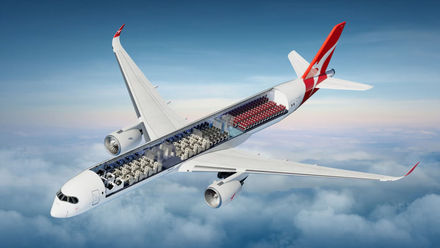
Qantas is positioning its incoming Airbus A350-1000ULR aircraft as the operational backbone of Project Sunrise, a program designed to establish nonstop service between Sydney Kingsford Smith Airport and both London Heathrow and New York JFK — routes that will exceed 20 hours of flight time and represent the longest scheduled commercial operations ever attempted. The carrier expects to take delivery of the first aircraft later in 2026. Rather than maximizing seat count on the larger A350-1000 airframe, which is certified for 350 to 400 passengers in a standard four-class configuration, Qantas has reduced its load to just 238 seats across four cabins — six in first class, 52 in business, 40 in premium economy, and 140 in economy. This deliberate capacity reduction, paired with a targeted 20 to 30 percent revenue premium per seat, reflects a calculated yield management strategy that prioritizes revenue per available seat mile over sheer passenger volume.
The A350-1000ULR variant represents a significant engineering adaptation over the standard -1000, which already carries a manufacturer-rated range of 9,000 nautical miles. Qantas has not yet published a confirmed range figure for its specific ULR variant, but the aircraft must exceed that baseline to operate Sydney-London and Sydney-JFK nonstop with required fuel reserves under ETOPS and long-range regulations. The airline drew directly from Singapore Airlines' experience operating the smaller A350-900ULR on its Singapore-Newark and Singapore-JFK routes — flights of 17 to 19 hours — where the carrier configured the aircraft for only 161 passengers with no economy cabin whatsoever. Qantas accepted the reduced-capacity model but chose to retain an economy class, differentiating its product by spreading amenity investment across all cabins rather than concentrating exclusively on the premium end. On-board wellness zones with stretch space and exercise guidance screens, along with self-serve refreshment stations accessible to all passengers, are part of the carrier's argument to justify above-market fares throughout the cabin hierarchy.
From an operational standpoint, the Project Sunrise routes will demand exceptional crew scheduling and regulatory compliance frameworks. Flights of this duration require augmented crew complements under both Australian CASA regulations and ICAO fatigue risk management standards, and Qantas will need to coordinate rest facilities onboard alongside its passenger wellness spaces. Crew rest provisions on the A350 family are built into the aircraft's design, but managing multi-crew relief rotations across 20-plus-hour flights while maintaining service standards in four cabins simultaneously represents a complex crewing and dispatch challenge. The Sydney-London sector in particular involves navigating multiple oceanic and overland FIR boundaries, necessitating precise fuel planning, weight and balance management at a heavily loaded departure, and contingency planning for diversions to airports along routes that traverse remote oceanic airspace for extended periods.
The broader commercial significance of Project Sunrise lies in its potential to redefine the premium long-haul market on Southern Hemisphere trunk routes. Qantas' existing Sydney-London product runs through Singapore Changi on both its A380 and Perth-routed 787-9 services, adding connection time and transfer inconvenience that nonstop passengers will pay to avoid. By holding a monopoly on the nonstop pairing — no other carrier has announced competing ultra-long-haul operations on either route — Qantas enters a pricing environment unconstrained by direct competition, at least in the near term. This mirrors the dynamic Singapore Airlines exploited successfully on its ULR routes to the U.S. East Coast, where the nonstop convenience premium proved durable in both business and premium leisure markets. For corporate flight departments and charter operators evaluating long-range transcontinental alternatives, the success or failure of Project Sunrise will serve as an important data point on the commercial viability of 20-plus-hour operations and the degree to which passenger wellness investment can sustain premium pricing on extreme-duration routes.










 Read original article