Over 130 Knots: Croatia Airlines Airbus A220 Veers Off Runway After Aborted Takeoff
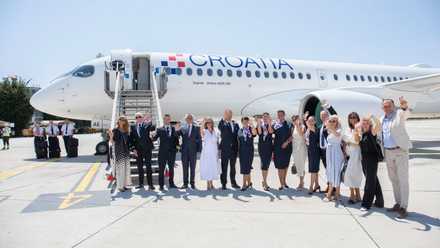
Croatia Airlines Flight OU412, an Airbus A220-300 registered 9A-CAN, suffered a runway excursion at Split Airport (SPU) on May 17, 2026, during a high-speed rejected takeoff on Runway 23 bound for Frankfurt. Flight tracking data from Flightradar24 recorded a maximum ground speed of 131 knots at the point of departure from the runway centerline, a figure at or potentially beyond the aircraft's calculated V1 for that operation. The aircraft veered sharply left, exiting onto the grass, striking runway signage and lighting, and traveling approximately 6,000 feet before coming to a stop. All 135 passengers and crew evacuated via airstairs with no reported injuries, though the aircraft sustained visible damage to its left engine cowling and lost at least one landing gear wheel during braking. Croatian air accident investigator AIN has opened a formal investigation, and Croatia Airlines has confirmed coordination with airport and regulatory authorities pending completion of initial inspections.
The core safety concern for flight crews lies in the combination of speed, directional control loss, and crosswind environment present during this event. A high-speed rejected takeoff — defined operationally as an abort initiated at or above approximately 100 knots — is among the most demanding maneuvers a crew can execute, requiring immediate, coordinated application of maximum braking, thrust reversal, and rudder authority. The fact that the excursion occurred at roughly 131 knots, near or at V1, raises serious questions about the sequence of events: whether the initiating event preceded V1 (making the rejection procedurally correct) or occurred at a point where continued takeoff should have been the commanded response. Crosswind gusts of up to 27 knots recorded by The Aviation Herald add complexity, as asymmetric thrust from a suspected left engine anomaly combined with a crosswind component from the right could produce a rapid, compounding yaw moment that even correct rudder inputs struggle to arrest at those speeds. Investigators will examine FDR and CVR data closely to reconstruct crew decision timing relative to the calculated V1 and the onset of the directional deviation.
For airline and corporate operators, this incident reinforces several well-established but persistently relevant training priorities. High-speed RTO events are statistically rare but disproportionately lethal when mishandled; the training calculus around V1 discipline — the principle that V1 is the last point at which a stop is assured within the available runway, not a threshold to be treated loosely — is fundamental to transport category operations. The A220's fly-by-wire architecture and its specific handling characteristics during asymmetric thrust conditions are factors that type-specific recurrent training must address. The crosswind component, while perhaps not causal, illustrates how environmental factors can amplify an already dynamic situation, a consideration equally applicable to Part 135 operators running narrowbody or turboprop equipment into shorter or less well-equipped fields. The crew's decision to evacuate via airstairs rather than slides also merits scrutiny in the post-incident review, as hot brake and potential fuel leak scenarios following a high-energy stop can evolve quickly.
The operational and commercial fallout for Croatia Airlines is substantial given the airline's limited fleet depth. With only 16 total aircraft — eight A220s constituting fully half of that number — the extended grounding of 9A-CAN, delivered just under a year ago in June 2025, removes a significant fraction of the carrier's narrowbody capacity at the outset of the summer peak travel season. Split Airport's position as a primary gateway to the Dalmatian Coast means that disruptions there cascade quickly into tourist and connecting itineraries across southern Europe. The incident also arrives at a strategically sensitive moment for the A220 program broadly: Croatia Airlines has positioned the type as the centerpiece of its fleet modernization, and any prolonged repair timeline will test the airline's ability to maintain schedule integrity with its remaining A319s and turboprops. Airbus's customer support response and the speed with which MRO access can be arranged for a relatively young airframe will be watched closely by other small European carriers evaluating similar fleet transitions.





 Read original article